
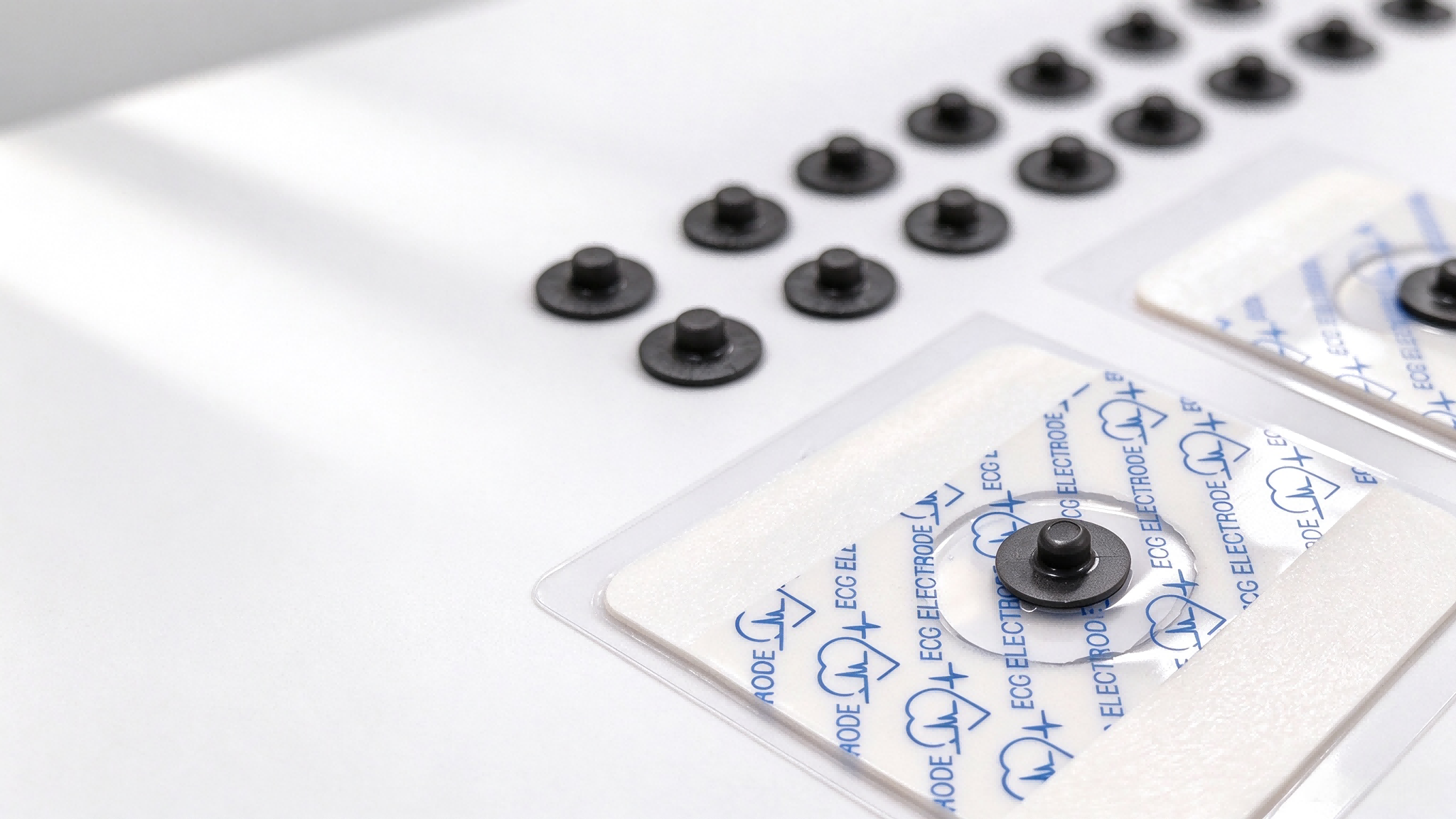
How to Choose an ECG Electrode — A Practical Selection Guide
2026-10-17
This guide walks through the key selection dimensions.
Part 1: Conductive Element — Standard vs. Radiolucent
Standard electrodes use an ABS base with an Ag/AgCl conductive layer — the clinical standard for routine monitoring in general wards, ICUs, operating rooms, and emergency departments.
Radiolucent electrodes replace the ABS base with a carbon-based material while keeping the Ag/AgCl conductive layer. This design is intended for clinical environments where X-ray imaging is performed simultaneously with ECG monitoring.
Selection consideration: Is X-ray imaging performed during monitoring? If yes, radiolucent electrodes are the appropriate choice. If not, standard electrodes remain the default.
The technical principles and clinical applications of radiolucent electrodes will be covered in the next edition of this guide.
Part 2: Backing Material — Foam vs. Non-Wove
Selection consideration: How long will the electrode stay on the patient? What is the patient's activity level and skin condition? Foam backing is better suited for short-term, high-sweat, or motion-intensive scenarios. Non-woven backing is preferable for long-term monitoring, sensitive skin, and pediatric patients.
Part 3: Shape and Size
Electrodes come in different shapes — round, oval, rectangular — and two size options for pediatric and adult patients.
Selection consideration: Electrode size should match the patient's body surface. An undersized electrode on an adult may not provide stable contact; an oversized electrode on a pediatric patient can cause edge lift and poor adhesion.
Part 4: Wired vs. Wireless
Selection consideration: Pre-attached leadwire electrodes reduce the number of connection points, which can streamline setup in busy clinical environments. Standard electrodes offer more flexibility in lead wire selection.
Part 5: Selection Decision Table
Part 1: Conductive Element — Standard vs. Radiolucent
| Component | Standard Electrode | Radiolucent Electrode |
| Conductive element | ABS + silver/silver chloride (Ag/AgCl) | Carbon-based material + silver/silver chloride (Ag/AgCl) |
Radiolucent electrodes replace the ABS base with a carbon-based material while keeping the Ag/AgCl conductive layer. This design is intended for clinical environments where X-ray imaging is performed simultaneously with ECG monitoring.
Selection consideration: Is X-ray imaging performed during monitoring? If yes, radiolucent electrodes are the appropriate choice. If not, standard electrodes remain the default.
The technical principles and clinical applications of radiolucent electrodes will be covered in the next edition of this guide.
Part 2: Backing Material — Foam vs. Non-Wove
| Backing Material | Characteristics | Typical Use |
| Foam | Strong adhesion and sweat resistance; stable during movement; elastic cushioning | Stress testing, emergency, intraoperative, short-term high-sweat monitoring |
| Non-Woven (Spunlace) | High breathability; soft and lightweight; suitable for sensitive skin | ICU long-term monitoring, pediatric patients, sensitive skin, continuous monitoring |
Part 3: Shape and Size
Electrodes come in different shapes — round, oval, rectangular — and two size options for pediatric and adult patients.
| Patient Population | Size Consideration |
| Adult | Larger conductive surface area for stable signal acquisition |
| Pediatric | Smaller size to match reduced chest circumference and more delicate skin |
Part 4: Wired vs. Wireless
| Type | Description | Typical Use |
| Without leadwire | Standard electrode; requires separate lead wire connection | Routine monitoring; flexible lead wire selection |
| With pre-attached leadwire | Eletrode and lead wire integrated into one unit | High-efficiency settings; reduced connection steps |
Part 5: Selection Decision Table
| Clinical Scenario | Recommended Electrode |
| Routine ward monitoring | Standard electrode, foam or non-woven, adult size, without leadwire |
| ICU / OR monitoring | Standard electrode, foam or non-woven, adult or pediatric size, with or without leadwire |
| Pediatric / sensitive skin | Standard electrode, non-woven backing, pediatric size |
| Stress testing / high-sweat | Standard electrode, foam backing, adult size |
| Cath lab / interventional radiology | Radiolucent electrode, foam backing, adult size |
| CT-guided procedure | Radiolucent electrode, foam backing, adult size |
| High-turnover area (ER, outpatient) | Standard electrode, non-woven or foam backing, adult size, with pre-attached leadwire |
Final Takeaway
There is no single "best" ECG electrode — only the electrode that best fits the patient, and the clinical setting. Understanding the available options makes the selection process faster and more accurate.
Explore life signal, benefit universal health.
---------------------------------------------------------
APK Technology, a national high-tech enterprise with over 20 years of professional technologies and experience in providing OEM/0DM services for world-leading monitoring and ECG brands, delivering high-quality solutions for the global healthcare industry.
Learn more about:
What Is a Radiolucent ECG Electrode — and Why Does It Matter in Imaging and Cath Lab Settings?
How to Read an ECG Waveform — A Practical Guide for Clinicians and Engineers
Related Article
In the last edition, we introduced the selection framework for ECG electrodes — including the difference between standard and radiolucent conductive elements. Standard electrodes use an ABS base with an Ag/AgCl layer. Radiolucent electrodes replace the ABS base with a carbon-based material.
This article takes a closer look at the radiolucent electrode: why it exists, what's different inside, and where it matters most.
What Is a Radiolucent ECG Electrode — and Why Does It Matter in Imaging and Cath Lab Settings?

In our last edition, we explored a question that most people never think to ask: when an ECG report says "Normal", how reliable is that conclusion?
The answer came down to signal quality — and the chain of components that carry the heart's electrical signal from the patient to the monitor.
How to Read an ECG Waveform — A Practical Guide for Clinicians and Engineers

You've just finished your annual health check. The doctor hands you a stack of reports. You flip to the ECG page, and there it is — a long strip of squiggly lines, a few numbers, and a single line at the bottom:"Sinus rhythm. Normal ECG."
You close the report and move on with your day.
But have you ever wondered — what does that line actually mean? And could a "normal" reading ever be wrong?
You close the report and move on with your day.
But have you ever wondered — what does that line actually mean? And could a "normal" reading ever be wrong?
Your ECG Report Says "Normal" — But Is That Conclusion Reliable?